
Introduction
Debt investments are often viewed through a narrow lens—primarily as a source of stability or predictable returns.
However, the role of debt within a portfolio extends beyond return expectations. It is a critical component of overall portfolio structure, influencing risk, liquidity, and consistency of outcomes.
In today’s environment—characterised by changing interest rate cycles and evolving market conditions—it becomes important to revisit how debt allocation is approached.
Moving Beyond Return Comparisons
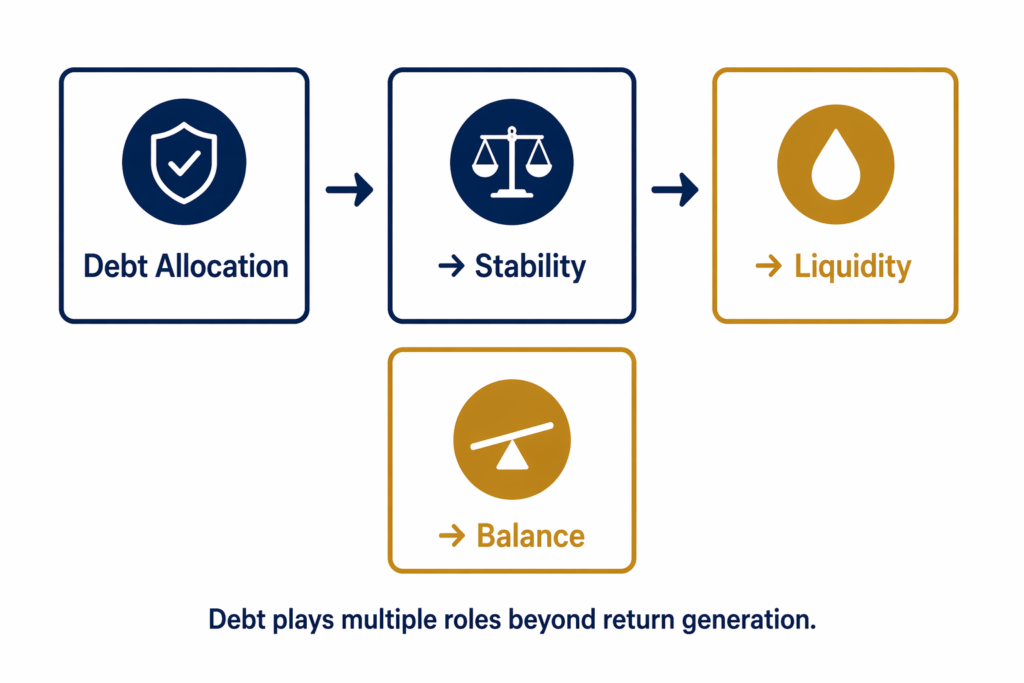
- To provide stability during periods of market volatility
- To act as a counterbalance within the portfolio
- To ensure liquidity when needed
A common way of evaluating debt investments is by comparing their returns to equity or other asset classes.
This approach, while intuitive, can be misleading.
Debt is not intended to compete with equity in terms of return potential. Its role is different:
Evaluating debt purely on return may lead to under-allocation at precisely the time when its role
becomes most important.
Role of Debt in a Portfolio
The Impact of Interest Rate Cycles
Interest rates influence the behaviour of debt instruments.
- When rates rise:
- New investments may offer higher yields
- Existing holdings may experience temporary price adjustments
- When rates stabilise or decline:
- Price movements may support returns
- Yield expectations adjust accordingly
Rather than attempting to position around these cycles, a structured allocation approach
recognises that such movements are part of the broader environment.
Duration and Sensitivity
Not all debt investments behave the same way.
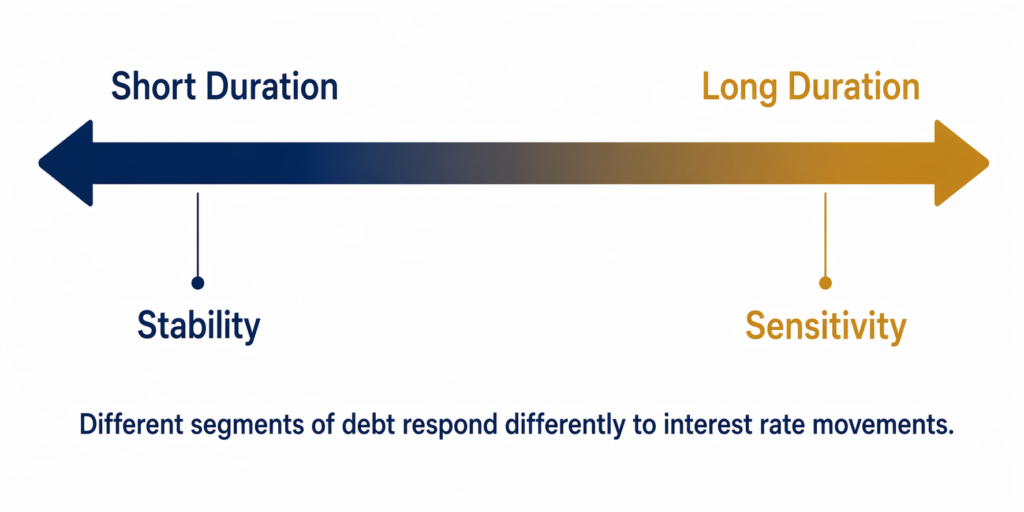
- One key differentiator is duration, which determines sensitivity to interest rate changes.
- Short-duration instruments tend to be more stable
- Longer-duration instruments may be more sensitive to rate movements
- A well-constructed debt allocation typically includes a balance, aligned with the investor’s:
- Time horizon
- Risk tolerance
- Liquidity requirements
Duration Spectrum
The Importance of Credit Quality
In search of higher yields, investors may be drawn toward lower-rated instruments.
- While these may offer incremental return potential, they also introduce:
- Credit risk
- Potential for capital volatility
- Reduced predictability
A disciplined approach to debt allocation prioritises credit quality, ensuring that the role of
stability is not compromised.
Aligning Debt Allocation with Objectives
Debt allocation should not be determined in isolation.
- It should be viewed in the context of:
- Overall asset allocation
- Financial goals
- Time horizon
For example:
- Near-term goals may require higher allocation to stable, liquid instruments
- Longer-term portfolios may incorporate a broader mix within debt
The objective is alignment, not optimisation based on current market conditions.
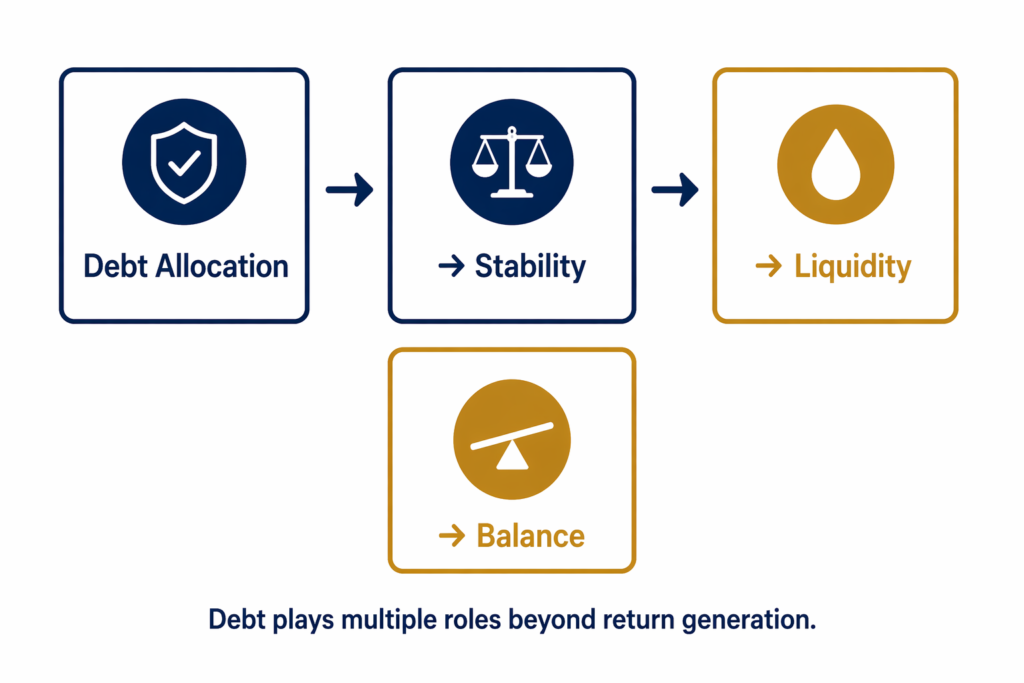
Visual 3: Allocation Alignment
A Structured Approach in Today’s Context
In the current environment, where interest rates and market conditions continue to evolve, the emphasis should remain on structure rather than reaction.
This involves:
- Maintaining appropriate allocation
- Ensuring diversification within debt
- Avoiding frequent shifts based on short-term views
Such an approach reduces the need to constantly interpret market signals and helps maintain
consistency.
Conclusion
Debt is often underappreciated when markets are performing well and overemphasised during periods of uncertainty.
A more balanced perspective recognises its role as a stabilising force within a portfolio.
By focusing on structure, credit quality, and alignment with long-term objectives, investors can ensure that debt allocation continues to serve its intended purpose—regardless of the prevailing market environment.
At Assetnova Capital, our approach to debt allocation is guided by its role within the broader portfolio—focused on stability, balance, and long-term alignment.