
Introduction
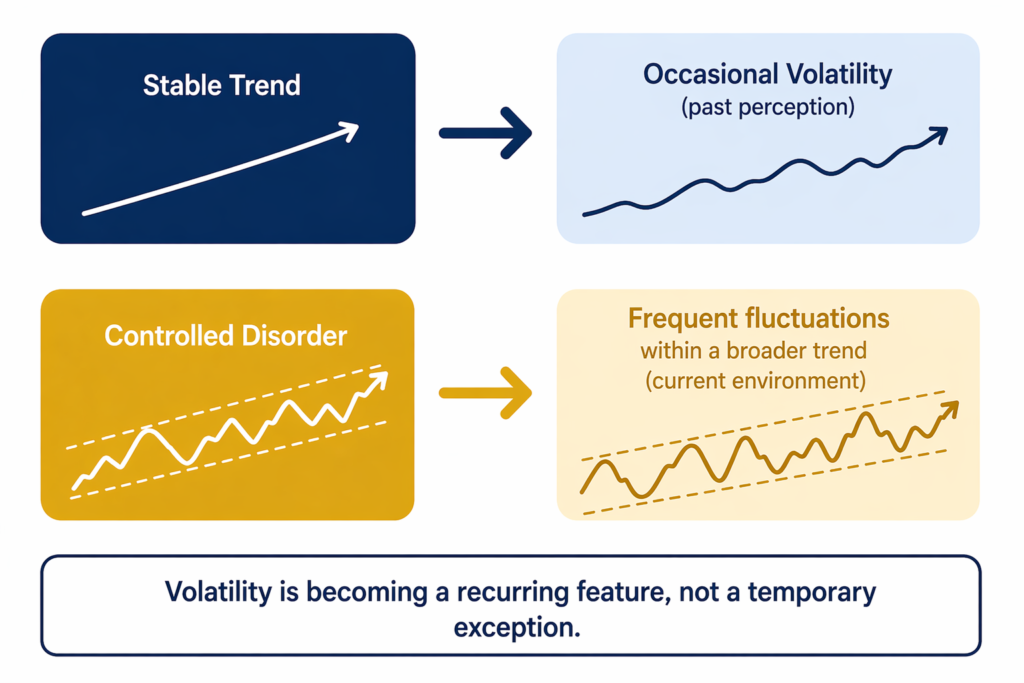
Market volatility is often viewed as a temporary phase—an interruption to an otherwise stable trend.
However, in the current global environment, volatility appears less like an exception and more like a recurring feature.
Shifts in monetary policy, geopolitical developments, inflation dynamics, and global interdependencies are contributing to what can be described as a phase of “controlled disorder”—where markets continue to function, but with frequent and sometimes sharp
adjustments.
For investors, the question is not how to avoid volatility, but how to respond to it.
Understanding “Controlled Disorder”
Markets today are influenced by multiple forces acting simultaneously:
- Central bank policy shifts
- Geopolitical uncertainty
- Supply chain adjustments
- Changing growth expectations
These factors do not always move in alignment.
As a result, markets may:
- React quickly to new information
- Reverse direction over short periods
- Exhibit higher-than-average fluctuations
Despite this, the broader system continues to operate, creating an environment of ongoing but
manageable instability.
Market Environment
Why Volatility Is Likely to Persist
Several structural factors contribute to sustained volatility:
1. Policy Sensitivity: Markets are highly responsive to central bank actions, particularly around interest rates and
liquidity.
2. Global Interconnectedness: Events in one region can quickly influence markets elsewhere.
3. Information Flow: Rapid dissemination of information leads to faster market reactions.
4. Uncertain Growth Outlook: Divergence in economic growth across regions creates uneven market responses.
These factors suggest that volatility is not simply cyclical, but increasingly structural.
The Cost of Responding to Volatility
Volatility often triggers a desire to act.
Common responses include:
- Reducing exposure during declines
- Increasing exposure after recoveries
- Shifting allocations based on recent performance
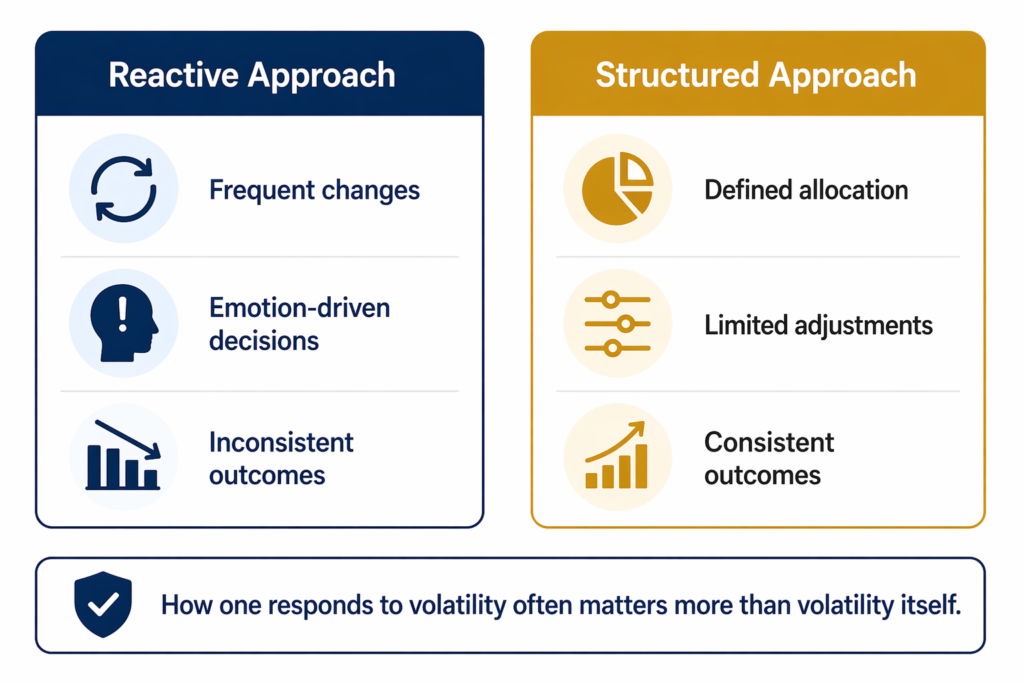
While these actions may feel rational in the moment, they can introduce:
- Inconsistency in decision-making
- Increased transaction activity
- Misalignment with long-term objectives
Over time, this can affect overall portfolio outcomes.
Reaction vs Stability
Reframing Volatility
Instead of viewing volatility as a risk to be avoided, it can be understood as a characteristic of
markets.
This shift in perspective helps:
- Reduce the urgency to react
- Encourage adherence to a structured approach
- Maintain focus on long-term objectives
Volatility, in itself, does not determine outcomes—how it is navigated does.
The Role of Asset Allocation
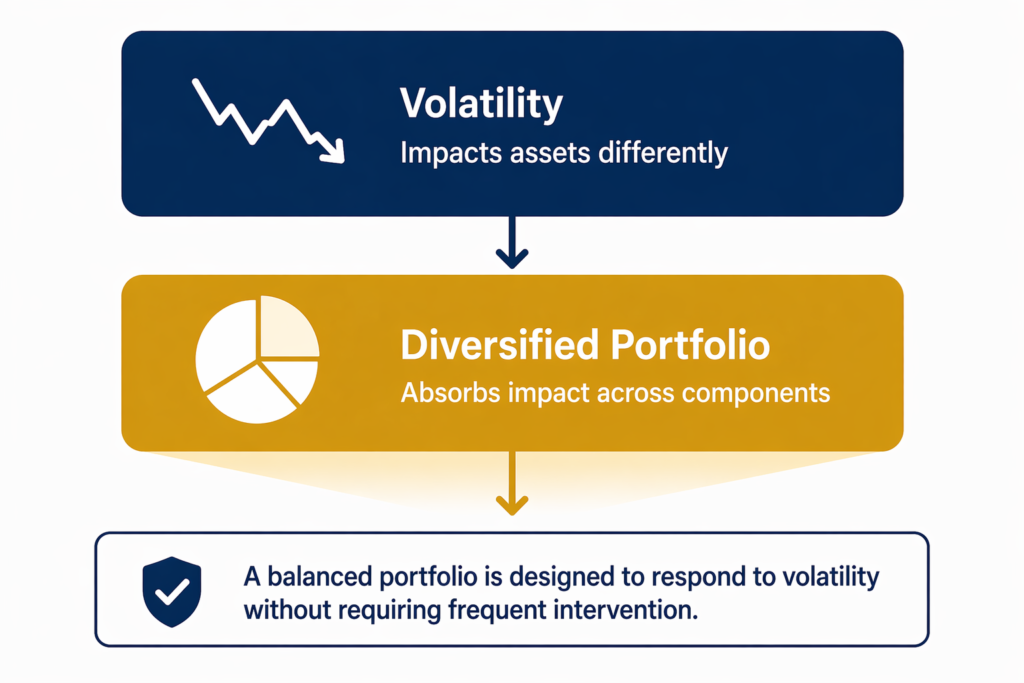
A well-constructed asset allocation provides a framework for navigating volatility.
By balancing exposure across asset classes:
- Equity contributes to long-term growth
- Debt provides relative stability
- Diversifying elements help manage risk
This structure allows portfolios to absorb fluctuations without requiring constant adjustment.
Portfolio Balance
Maintaining Discipline
Periods of volatility test discipline.
It is during such phases that:
- The temptation to deviate from strategy increases
- Short-term developments feel more significant
- Long-term plans are questioned
Maintaining consistency during these periods is often more important than making new
decisions.
A Measured Response
Responding to volatility does not mean inaction—it means measured action.
This includes:
- Periodic portfolio review
- Rebalancing when necessary
- Ensuring alignment with long-term goals
Rather than reacting to each movement, decisions are made within a defined framework.
Conclusion
Volatility is likely to remain a persistent feature of the market environment.
Attempting to eliminate or avoid it may not be practical. However, responding to it with structure and discipline can make a meaningful difference.
A well-defined approach provides stability—not by removing volatility, but by ensuring that it does not dictate decision-making.
At Assetnova Capital, we focus on helping clients navigate volatility through structured allocation and disciplined execution—ensuring that short-term fluctuations do not disrupt long-term outcomes.