
Introduction
Gold has held a unique place in investment portfolios for generations.
It is often associated with safety, store of value, and protection during uncertain times. Yet, its role within a modern investment portfolio is often misunderstood—either overemphasised during periods of volatility or overlooked during stable market phases.
A more considered approach is to view gold not as a standalone investment decision, but as a component within a broader portfolio framework.
Moving Beyond Traditional Perceptions
Gold is frequently approached with strong expectations:
- As a hedge against inflation
- As protection during market declines
- As a long-term store of value
While these characteristics may hold under certain conditions, they are not consistent across all time periods.
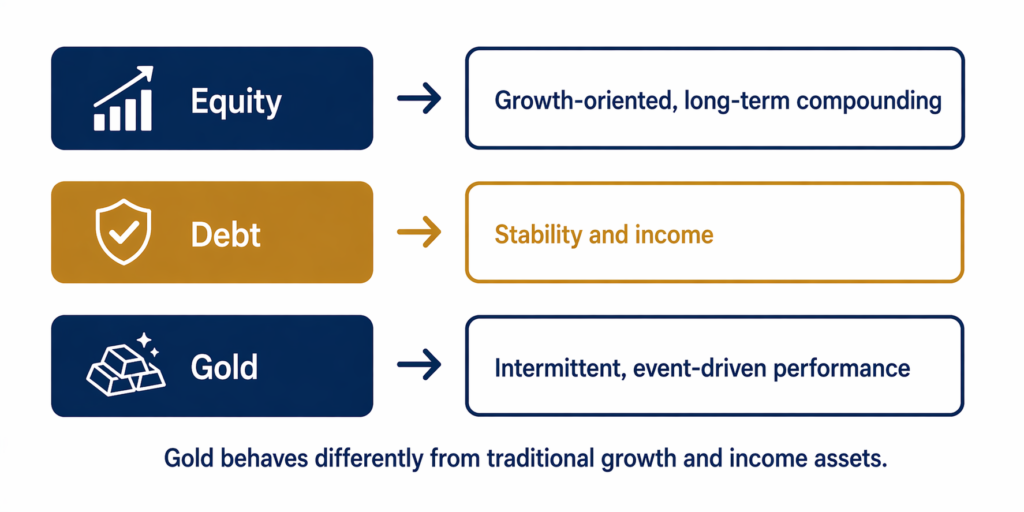
Gold does not generate income, and its returns can be uneven over time. This makes it less suitable as a primary driver of portfolio growth.
Nature of Gold Returns
The Role of Gold in a Portfolio
The value of gold lies not in its standalone return potential, but in how it interacts with other
asset classes.
Gold tends to:
- Respond differently to economic conditions
- Perform during periods of uncertainty or stress
- Exhibit low correlation with equity over certain cycles
This makes it useful as a diversifying component, rather than a core allocation.
Gold and Uncertainty
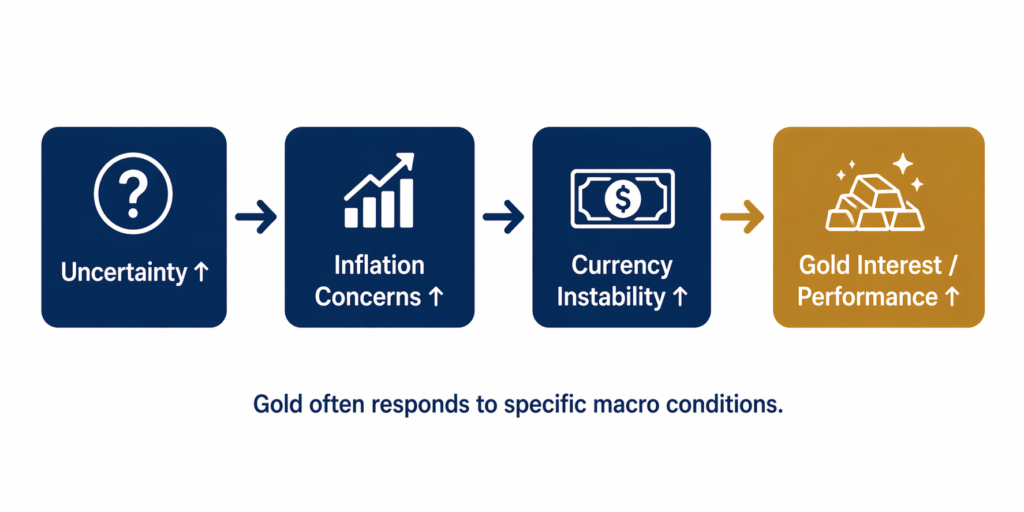
Gold often attracts attention during periods of:
- Geopolitical tension
- Currency instability
- Inflation concerns
In such environments, it may act as a store of value.
However, these conditions are not constant, and gold’s performance outside such periods can be relatively muted.
When Gold Tends to Perform
Allocation, Not Timing
One of the common approaches to gold is to increase exposure during uncertain periods and reduce it when conditions stabilise.
This introduces a timing element, which can be difficult to execute consistently.
A more structured approach is to:
- Maintain a defined allocation
- Use gold as a stabilising component
- Avoid frequent adjustments based on short-term developments
This shifts the focus from prediction to balance.
How Much Allocation Is Appropriate?
There is no universal allocation to gold.
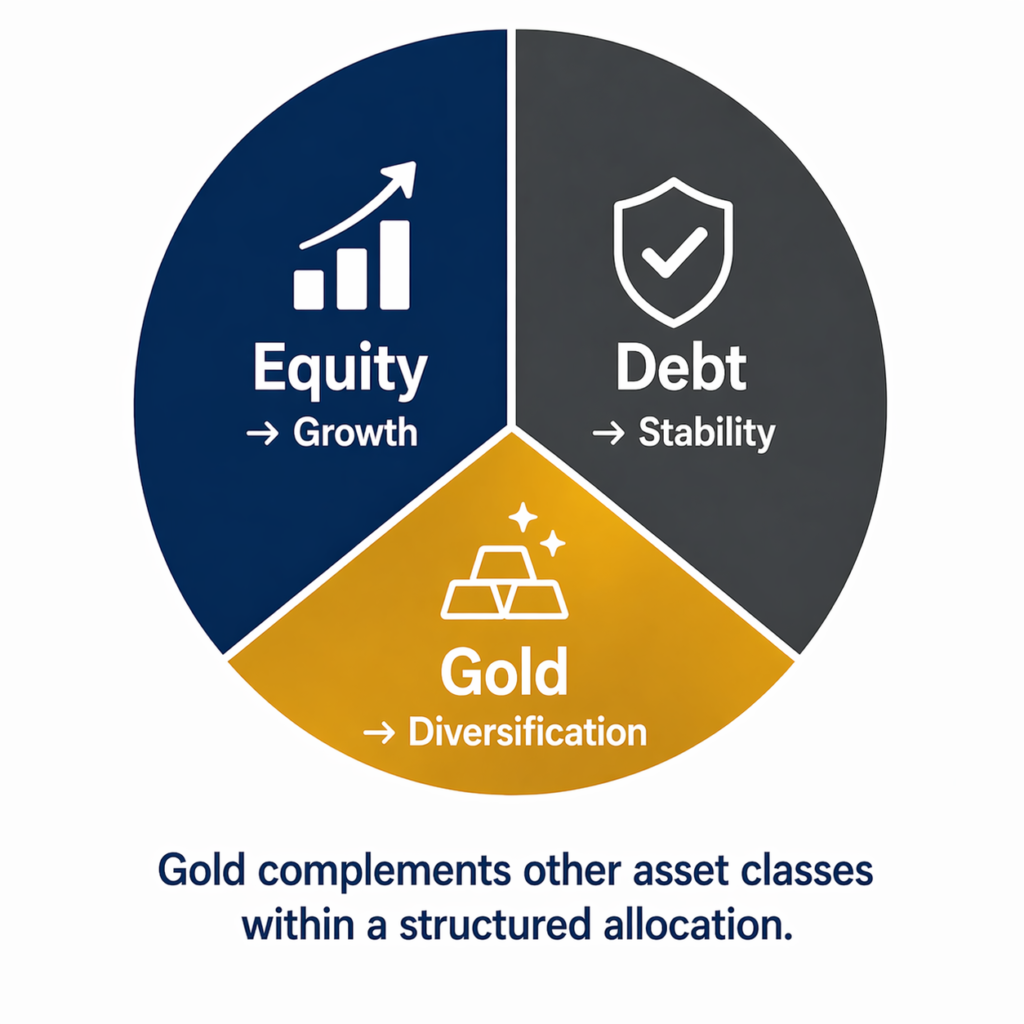
However, within a diversified portfolio, gold is typically:
- A moderate allocation, not dominant
- Positioned alongside equity and debt
- Aligned with overall portfolio objectives
The emphasis is on its role as a complement, not a substitute.
Visual 3: Balanced Portfolio Structure
Avoiding Over-Allocation
Gold tends to receive increased attention during periods of uncertainty.
This can lead to:
- Over-allocation at higher price levels
- Reduced exposure to growth assets
- Portfolio imbalance over time
Maintaining discipline in allocation helps avoid such outcomes.
A Modern Perspective
In a modern portfolio, gold should be viewed through the lens of:
- Diversification
- Risk management
- Portfolio balance
Rather than as a reaction to current events, it should be integrated as part of a broader allocation strategy.
Conclusion
Gold continues to hold relevance in investment portfolios, but its role is often misunderstood.
It is neither a primary growth driver nor a consistently stable asset. Its value lies in how it interacts with other components of a portfolio.
By approaching gold as a diversifying element within a structured framework, investors can incorporate it effectively—without over-relying on it during periods of uncertainty.
At Assetnova Capital, we view gold as a component within a broader allocation strategy—used thoughtfully to enhance balance and resilience over time.